A beginner's guide to train travel in Japan

The train network in Japan is huge and highly efficient but can be also be highly confusing. However, once you get your head around it, it’s spectacular. Hopefully this guide to train travel in Japan helps to clear some things up.
Firstly, there are many types of trains and rail companies in Japan - tickets are not interchangeable between companies. There are also a number of regional passes that cover some rail networks within a certain region (but not all). It can take some time to work out the most efficient tickets/passes to use - we’ll list all of the passes we used for our 2 week itinerary.
Disclaimer - this article contains affiliate links, which means we receive a commission if you decide to book/purchase via the link, at no extra cost to you. We will only ever recommend services, tours and operators that we have personally used and consider good value.

Generally, these are the types of trains/tickets you may need:
Subway/Metro - underground trains similar to underground systems in other parts of the world.
Local/express/limited express/rapid train services - overland trains that use the same lines but speed depends on how many stops there are. For example, see the image below for the journey between Osaka Namba and Kintetsu-Nara: the local train stops at every stop, whereas the limited express stops the least and is therefore the quickest.
Shinkansen - the “bullet trains”. These are usually in a separate area of the station as they run on specific high speed tracks (not the same as the other trains).

This image demonstrates the differences between the local trains on the line from Osaka to Nara:
The limited express makes the fewest stops and therefore is the quickest train. The other trains run on the same line but make increasing numbers of stops, with the local train stopping at every single station on the line.
Source:
Using the Metro
I would recommend using an IC card/Suica (see below) as it makes it so much quicker to just tap your card/phone without having to find a ticket machine every time you want to make a metro journey. Alternatively, you can buy physical tickets or multi day passes. We bought a 3 day pass for Tokyo, but used the Suica IC card on my phone wallet for all other metro/subway journeys.
Journey planning
Use either Google maps or the Japan Travel by Navitime app to plan your metro journeys. Both are excellent for mapping your journeys in real time, especially the metro, as they will tell you which entrance and exit to use in the stations, which is a huge help because there are often many! There’s often many ways of making the same journey - the apps will show you options with the fastest route first depending on your departure time. Don’t panic too much if you get lost/confused in the stations (easily done) and miss the train on the line you had planned - the next one will usually only be a few minutes away. I found it best to stick to a route and wait rather than trying to retrace steps across the station and find another line to save a few minutes (and risk missing that one too).
JR Pass
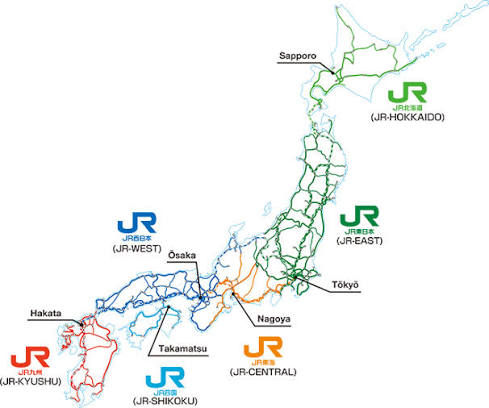
Since the price of the JR pass increased in recent years, there is a lot of debate over whether it will actually save you money. This is completely dependant on your itinerary. I think the biggest gripe that tourists have with the JR pass is that they expect it to cover every transport medium they will need in Japan and are shocked when they then have to pay extra for services that are not covered. The key thing to understand is that JR or “Japan Rail” is one of the many train companies in Japan, it doesn’t mean the whole Japan rail system, which I think is where the confusion stems from.
To further complicate things, there is the whole Japan JR pass, as well as regional options. The JR pass will cover many (but not all) bullet trains, some other trains, buses and even some ferries.
You can choose the duration of the pass: 7, 14 or 21 days.
Even if you plan to visit Japan for 2 weeks, you don’t necessarily need the 14 days pass. You can plan your trip to use the 7 day pass in the middle to maximise your travel. Our itinerary made use of this - just bear in mind that it is valid for 7 consecutive days from activation, so plan your days wisely.
Do you need to book seats?
The only train we booked seats for in advance was the shinkansen to and from the sumo tournament in Fukuoka. This is because we knew in advance which train times we needed and were concerned that the last train from the tournament was likely to be busy (and we were correct!). Otherwise, you will probably be able to find a seat in the non-reserved cars. One caveat to this is if you’re travelling at very busy times of the year eg. Golden Week (usually around the start of May) - the JR website lists key dates to consider.
While most trains have non-reserved sections (we always found seats), some shinkansens only have reserved seating cars. The ones relevant to our itinerary were Nozomi and Mizuho trains. These trains are not actually included in the JR pass anyway but you can use them for an additional fee (reduced compared to the full fare for either of these trains). Book these at a ticket machine or office in a JR station. We only used one once in order to save time, but you could actually do this itinerary without needing either.
So is it worth it?
The short answer - it depends on your itinerary. For us, it was very slightly cheaper to use the JR pass, but not massively. However, the advantage to us was a degree of flexibility - I over-planned one day and we missed our train. Having the JR pass meant we could just jump on the next train without losing any money, and didn’t have to queue at a ticket machine when in a rush.
There is a great website which you can use to plot your expected journeys and calculate whether it will be cheaper using the JR pass or booking the journeys separately.
Caveat - I used the Navitime website at the time of our trip, but recently it’s seems to be glitching - I searched journeys that I know to be covered by JR and it wasn’t recognising this…
This alternative calculator is the most accurate that I could find in 2026:
Navitime: The JR calculator by Japan Travel Navitime
How do I buy a JR pass?
You cannot purchase a JR pass in Japan - it must be done before your trip - it's a bit of a convoluted process:
Be aware that there are a number of different JR websites that look official but may not be. We ordered ours through the Klook app (find our discount code here for up to 10% off)
To order the JR pass, you need to leave enough time (it’s generally recommended 1-2 months before your trip) because the “Exchange order” with be posted to your address.
You must bring this with you to Japan and exchange it for the physical JR passes at a JR office.
Here, you can choose the date of activation - it does not need to be the same date that you collect your pass. For example, we arrived into Osaka KIX airport and immediately went the the JR office in the airport. Here, I collected the passes and opted for activation 3 days later. I also made the seat reservations for the journey to the sumo tournament at the same time.
A note on IC cards
IC cards are rechargeable cards (either physical or digital) that can be used to pay for train services, some vending machines and in some shops (we found that many stalls in train stations would only accept cash or IC cards, not credit/debit cards). There’s lots of different cards, depending on which region/city they are issued in. Examples are Suica, Icoca and Pasmo. It doesn’t matter which one you have, it can be used all over Japan.
Apparently, you can’t use it to pay for a journey that crosses regions - not relevant to our itinerary but just keep this in mind in case you’re going off piste!
We each added a Suica to our Apple wallet on our phones and found it convenient to top up using a debit card when needed. You can’t withdraw unused funds, so in the last few days of the trip, we kept an eye on the balance and just topped up what was needed for the last payment.
Alternatively, you can pick up a physical IC card at a train station, but you will need to put down a deposit - this is refundable but only if you return the card in the region it was purchased. We arrived in Osaka and departed from Tokyo so would not have been able to get the deposit back. With a physical IC card, your remaining balance will show on the barrier when tapping it to go through. You can top these up at 7/11, Family Mart and other combines, but with cash only.

It seems that, for Android users, the app/wallet doesn’t work for tourists for a number of reasons, so you will need to get a physical IC card instead.
If you’re arriving into Tokyo, there is a visitor version of the physical Suica card, called the “Welcome Suica” which can only be purchased from Narita or Haneda airport on arrival. This does not require a deposit, and is valid for 28 days. You can add money to these at designated ticket machines in train stations and at Seven Bank ATMs at 7/11 stores. This can only be done with yen in cash (you can’t top up a physical Suica with your credit/debit card). Try to use up the remaining balance as you cannot get it refunded.
So which tickets and passes to buy ?
These passes/ tickets covered all of our transport in Japan (excluding the odd Uber). For more details, see the itinerary.
IC card for the metros, the limited express to Nara, and other rides not covered by JR.
JR pass, activated on day 4.
Bus tickets booked via Japan Bus online
Hakone freepass
Tokyo 3 day subway pass - also valid on buses.
All of our resources are FREE, but if you found them helpful, you can buy us a coffee here, so we can get a much-appreciated caffeine hit and keep providing you with travel hacks and budgeting tips.
Enjoyed this post? Subscribe below to be the first to receive updates on blogs, travel guide releases and more!

Comments